
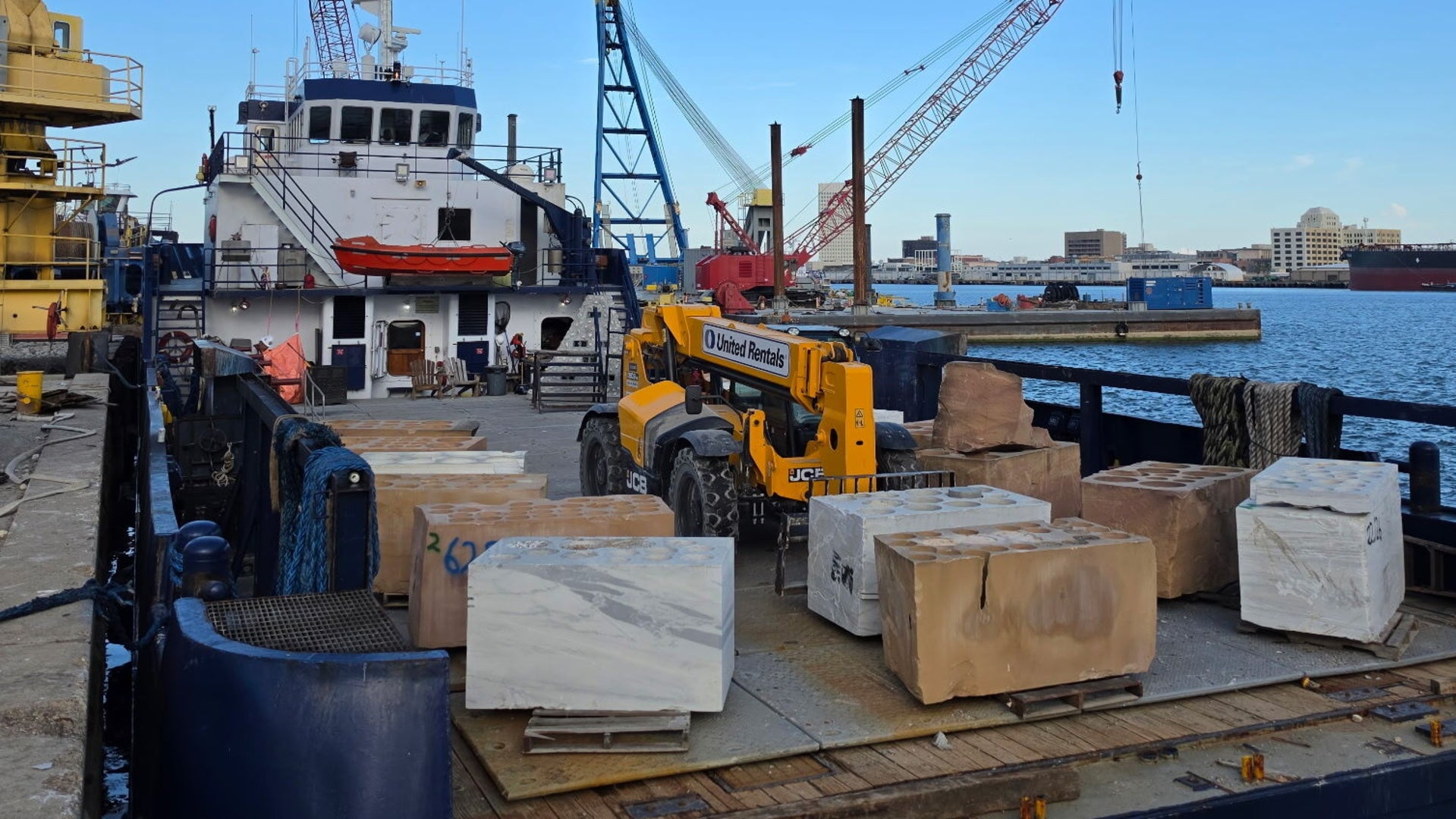
Rather than send them for disposal, our Conroe team has continued an employee-led initiative that started years ago: donating eligible blocks to the Texas Parks and Wildlife Department for artificial reef projects in the US Gulf.
A new purpose offshore Texas
The latest donation supported the creation of HI-54 Deep, one of the largest artificial reefs constructed along the Texas Gulf Coast. This 160-acre reef site is approximately 9 miles (14 km) offshore in 48 ft (15 m) of water.
Our quarry blocks joined materials donated by other organizations, including 300 concrete pyramids, 102 concrete culverts, 400 tons of concrete railroad ties, 100 low-relief habitat plates, and numerous concrete piling cutoffs. Together, they create durable underwater structures that provide a habitat for fish and other marine life.
Once deployed, the quarry blocks’ drilled openings offer protected spaces for fish, such as red snapper and grouper, while their irregular surfaces allow coral, barnacles, and other marine life to attach and grow. At nearly 4 ft x 4 ft (1 m x 1 m) and weighing more than 3 tons, the blocks can remain in place on the seafloor during hurricanes.
HI-54 Deep is the third artificial reef developed through collaboration among the Texas Parks and Wildlife Department, Friends of Sabine Reefs, Coastal Conservation Association Texas, and industry partners.
According to Mic Cowart, co-founder of Friends of Sabine Reefs, a non-profit organization, the value of HI-54 Deep extends beyond creating a habitat for marine life. Its location within state waters gives anglers, including those in smaller boats, access to another fishing destination close to shore. Artificial reef projects also support the local economy and quality of life by expanding recreational opportunities along the Texas Gulf Coast.
“The HI-54 Deep Artificial Reef is a win for the environment, recreational fishing, and our local community,” Cowart said. “Thanks to industry supporters like NOV, projects like this are possible.”
A lasting connection
Over the past decade, NOV ReedHycalog has donated 60 to 70 quarry blocks to the Texas Parks and Wildlife Department’s Artificial Reef Program. Shipments typically include 15 to 20 blocks and occur every few years, when the lab has accumulated enough and a reef project is ready to receive them. Blaylock coordinates the transportation of the blocks to Galveston, where they are transferred from trucks to a barge for deployment.
From the lab to the reef, this long-standing employee-led initiative strengthens the connection between our operations and the communities where we live and work.