A storytelling platform about our offshore challenges
Operating in its Element
Wind Ally and Wind Orca at Hornsea 3
Reading time: 3 min
In the North Sea, off the coast of Yorkshire, United Kingdom, Ørsted is developing one of the world’s largest offshore wind farms: Hornsea 3. With a planned capacity of 2.9 GW, it will generate enough renewable electricity to power more than 3.3 million UK homes. Laying the groundwork are Cadeler's Wind Ally and Wind Orca, two vessels equipped with GustoMSC technology.
The project calls for 197 monopile foundations, and Cadeler is responsible for transporting and installing each one. The first foundation was completed in May 2026, a milestone captured in the image above, with the two vessels working side by side.
A well-matched pair
Each vessel has a distinct role: Wind Ally is key to installing the monopiles for Hornsea 3, while Wind Orca completes them with the components required for safe access and long-term operation.
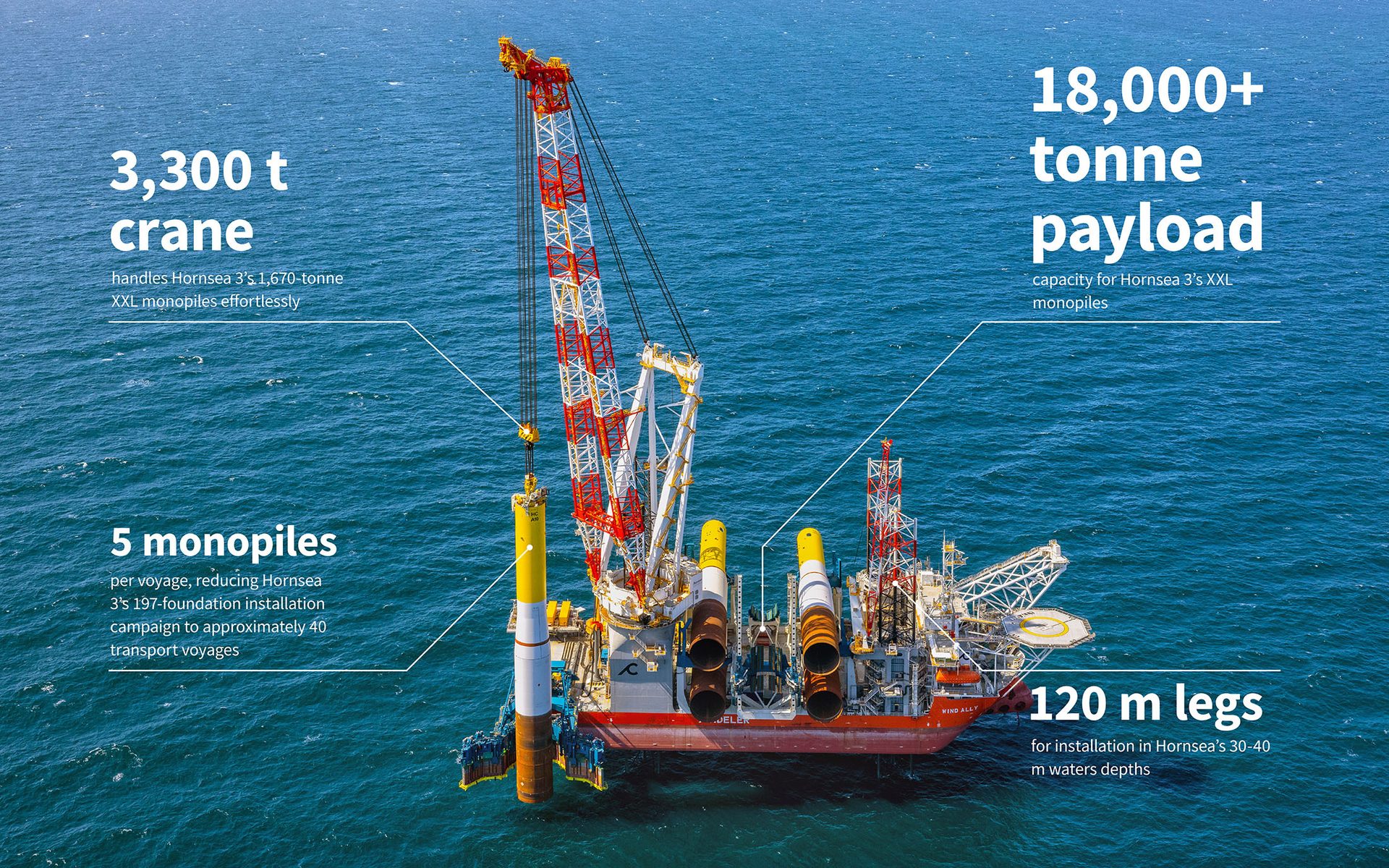
Wind Ally, Cadeler’s first A-class installation vessel, is based on the GustoMSC NG-20000X jack-up design. With 5,600 m² of deck space, a payload of more than 18,000 metric tons, and a main crane capable of lifting more than 3,300 metric tons, it can transport and install up to six sets of XXL monopile foundations per voyage. This reduces trips to port and keeps installation moving in a demanding offshore environment.
Working alongside it is Wind Orca, whose GustoMSC heavy-lift crane installs the secondary steel. This includes the platforms, ladders, boat landings, cable protection systems, and other structures that make a foundation accessible, serviceable, and ready for operation. While these components may be smaller than the monopile itself, installing them offshore still requires precision and lifting power.
In their element
The offshore image of Wind Ally and Wind Orca at Hornsea 3 tells the story in a single frame: two vessels equipped with GustoMSC technology, each built for its part of the job and working together to help deliver what will be one of the world’s largest offshore wind farms. The project is expected to be completed around the end of 2027. Until then, the work continues, one monopile and component at a time.
Hornsea 3 at a glance
Up to 2.9 GW of renewable generating capacity
Enough electricity to power more than 3.3 million UK homes
197 monopile foundations in Cadeler’s transport and installation scope
Located approximately 120 kilometers off Norfolk and 160 kilometers off Yorkshire
First complete monopile foundation installed in May 2026
Rethinking load cases for XL monopile installation
As monopile diameters surpass 10 metres, the lowering phase can generate structural demands comparable to and in some cases, exceeding survival conditions. Coupled dynamic interaction between the suspended pile and the supporting jack-up is emerging as a governing design consideration for offshore wind.